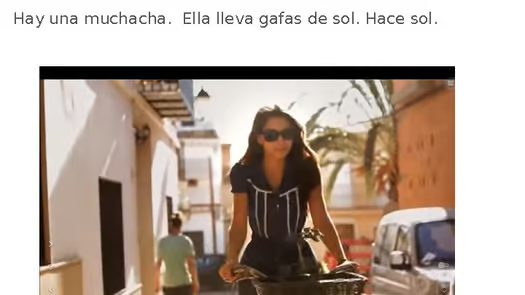
What is more high interest than a tomato fight to begin the school year? I start by using this presentation to introduce vocabulary and then movie talk this Ray-Ban commercial.
I then use the same presentation to present information about the festival followed by the true or false quiz.
Tomato Fight Time! Give students a red paper and have them write something about themselves in Spanish (or English if it is the first days of school in Spanish One). Students crumple the paper and with the official music playing, they have their own tomato fight for one minute. Once the time is up, students each pick up a piece of paper and try to find the classmate that wrote it. Or another option is to gather in a circle. The teacher reads these out in Spanish or English, and students guess who they are describing. Students can also write sentences about what they learned about their classmates.
Running Dictation: Copy these sentences on to separate pieces of paper or use these sentence strips and tape them around the room our outside in the hallway. Put students in groups of about 3 or 4. One student from each group runs to a sentence and comes back and says it to their group who try to write it word for word and then illustrate the picture while the next student runs out to read the next sentence.
La Tomatina es un festival famoso en España.
La Tomatina occure en Buñol, España.
La gente usa tomates maduros para la lucha.
Unos camiones traen muchas tomates.
Algunas personas usan gafas para proteger los ojos.
Muchas personas llevan camisetas blancas.
Muchas personas viajan a Buñol para la fiesta.
La tomatina se celebra el último miércoles de agosto.
Some books about La Tomatina in English. As an Amazon Associate I earn from qualifying purchases at no additional cost to you.
I start by reading the book to my learners several times with actions and sound effects.
Then I show them this video with the author Michael Rosen telling his story with sound effects and actions.
Then we sing these songs.
I use to sing this bear song at camp when I was a kid.
There are so many activities you can do with this book. Some crafts to make are bear headbands, binoculars, paper sack bear puppets, treasure maps, and sensory bins. The teaching expertise website has 30 fun ideas to use with this book.
We made a sensory bin to act out the story and add our own details. We used these free stick puppets and resources from TPT for sequencing and interactive story play.
Then because we have little ones who like to put everything in their mouths we made an edible sensory bin for another retell.
There are lots of free printables and activities on line to use with this story. Here are a few of my favorites.
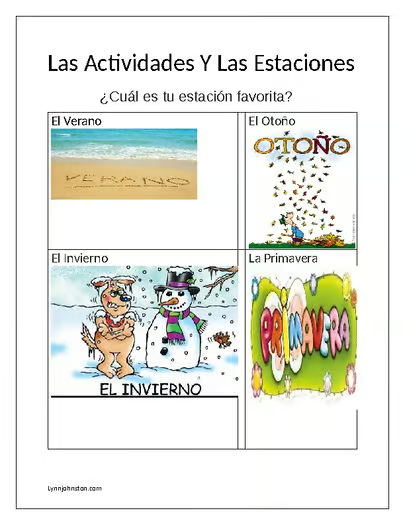
One of my favorite activities is what I call sentence sorts. This example is for seasons and hobbies but this can also be adapted to any topic. It also works really well for characters in a novel.
Create your own sentences or here are ready made sentences in French, Spanish, and English. If you teach another language get the English version and translate to your language.
Print out the four season headings and tape them in different places around the room so that the sentence strips may be placed underneath them.
Print out the sentences large enough for everyone to read or copy phrases onto sentence strips. I really like these magnetic dry erase strips. Put tape or poster putty on the back of each sentence strip. #commisionsearned
Mix up the sentences and distribute to students. You could also place them in a pile on the floor face down and have students select a sentence. I like to give students time to walk around and randomly read their sentence to several students. This allows them to practice and anyone who does not know what their sentence means or how to say it quickly comes to me for support.
Students come up one at a time and read their sentence to the class and stick it under the season in which they feel it belongs. Have the next student on deck ready to go so the activity progresses quickly. After everyone has gone once, you can have students pick up any remaining sentences and they can all go place them under the seasons at the same time.
Ask students if they agree or disagree with the season choice of the student, but the student with the strip gets to decide where it goes. Some are obvious, for example it’s Christmas, and some are debatable like it’s my favorite season or you can watch TV.
Use this time to repeat the sentences over and over asking students personalized questions, for example: Do you like to swim? Do you like to ski during the winter? Who travels with their family during the summer? What is your favorite season?
Once all sentences are categorized, have students organize sentences into paragraphs, one for each season with an illustration. I do the first season with them rearranging and pointing out which would be a good topic sentence, how to group like sentences together, how to vary the length of sentences, and how to end with an opinion or conclusion.
I have the students type their paragraphs in their Chromebooks. They are amazed that they just have to organize the sentences and type up the paragraphs. I love this activity because it involves listening, speaking, reading and writing and there is no Google translate or AI being used. I know the sentences are correct because I wrote them. To adjust this activity for upper levels change the verbs to the past, future, conditional or subjunctive tenses.
Also I introduce conjunctions and prepositional phrases to level up the language. You can make your own conjunction signs with magnetic sentence strips cut to size.
Another way I use sentence sorts is to describe characters in a novel. I write five to ten sentences about each character in the novel or story we are reading. I then post the name of each character around the room and distribute the sentences about the characters. Then go through the same process having students grab a sentence, read it to the class and decide which character that would describe and put that sentence under the appropriate character.
I hope you love this activity as much as I do. Let me know how this works for you or how you modify it.
Me encanta celebrar el dia de amor y el amistad! Valentine’s day is one of my favorite holidays. How can you not love a day that celebrates love and friendship. Here are some ideas to help you spread the love.
I use this presentation to start the lesson. I have students open a Google Document on their computers although you could also just use a piece of paper. I have them write the title and do a google search for El Dia de San Valentin and ad an image to their document.
As they watch the presentation the add five vocabulary words in Spanish with an image to illustrate the meaning, five symbols with images, five common gifts with images, and five sentences from the presentation.
One of my favorite activities I call Whip Around with Tally. I put a list of items on the board and quickly whip around the room asking every single kid the same question while a student tallies the responses on the board. In this case I ask what gift would you like to receive for Valentine’s day and where would you like to go for Valentine’s day?
After the whip around with tally I have students rank order their top five gifts and top five places they would like to go or things they would like to do for Valentine’s day. They then compare their answers with a partner. I also like to use a google form or on line poll to vote for their favorites.
Whenever possible I ask personal questions to increase classroom engagement.
I have my students make Valentine Cards for everyone in the class. Check out this previous post for details and links to resources.
J’adore célébrer la Saint-Valentin! What could be better than a day that celebrates love and friendship?
I use this presentation to start the lesson. I have students open a Google Document on their computers although you could also just use a piece of paper. I have them write the title above and do a google search for La Saint Valentin and add an image to begin their document.
As they watch the presentation, they add five vocabulary words in French with an image to illustrate the meaning, five symbols with images, five common gifts with images, and five sentences from the presentation.
One of my favorite activities I call Whip Around with Tally. I put a list of items on the board and quickly whip around the room asking every single kid the same question while a student tallies the responses on the board. In this case I ask what gift would you like to receive for Valentine’s day and where would you like to go for Valentine’s day?
After the whip around with tally I have students rank order their top five gifts and top five places they would like to go or things they would like to do for Valentine’s day. They then compare their answers with a partner. I also like to use a google formor on line poll to vote for their favorites.
Whenever possible I ask personal questions to increase classroom engagement.
I have my students make Valentine Cards for everyone in the class. Check out this previous post for details and links to resources.
This time of year, instead of dealing specifically with Halloween, I like to ask the question…What are you afraid of?
I start with this video. There is a worksheet to go with this video on the Real Language Right Away website. Here is the presentation I use for more input.
I have a list of common fears written on the white board in Spanish with a picture or a prop for each item. We then whip around the room quickly asking…¿De qué tienes miedo? We tally each person’s answer to find the most common fears for the class. I have students post their fears to a padlet with an image. I am always surprised that their biggest fear is usually spiders.
You can also have the students rank order their fears with a partner.
I like to give students this slide with links to songs, books, and videos related to things we fear. Basically it is a google slide with a background, layered with images, and links to book sites and Youtube videos. Click here to get a copy with the links.
I found some inexpensive books at Walmart and the dollar store in English. No problema, I made them bilingual by writing the Spanish word with a Sharpie.
A picture book can generate a thousand words. The book Good Night Gorila contains less then a dozen unique words but with it, I can generate a week’s work of lessons and discussions.
It’s not about how many words are in the book, it is about how many high frequency words I can use to describe it. I can add as much detail or as little detail as my students can handle.
Before the story I can build background knowledge about zoos and animals. Have you been to a zoo? Where? Which is your favorite zoo? Have you ever seen a gorila? Do you have a favorite animal? I can take a survey or launch a poll. I have them post their favorite animal on a padlet.
Here’s an example of the story being told in the simplest form.
And an example of the story being beefed up for upper levels.
I basically tell this story. There is a gorila. There is a mouse. Do you see the mouse? The mouse has a banana. There is a guard. The guard is tired. He is going home. He says goodbye to the little gorilla. The gorilla sees the keys of the guard. The little gorilla has a secret plan. What do you think he is going to do? The gorilla steals the keys. The little gorilla opens the door of the cage. He escapes. He does not close the door. The mouse escapes also with his banana. The gorilla and the mouse follow the guard. The guard does not see them. The guard says good night to the elephant and so on with the other animals. I can repeat key phrases like opens the door, closes the door, escapes, does not see, walks behind, says good night, sleeps, is afraid of, is not afraid of. I can describe the animals in more detail with colors and size. I can see if anyone is afraid of elephants, mice, lions or other animals. Here is an example of me telling the story in French and in Spanish.
I can make the setting cultural. I can make it the Parc Zoologique de Paris or Loro Parque in Madrid. We can investigate… do they have zoos in France and Spain, in all countries? We could then take a virtual field trip. We can make cultural comparisons. We can research and debate, are zoos good or bad for animals?
Reading skills like inferencing, sequencing, summarizing, and predicting can be incorporated throught questioning. Where do you think the animals are going? Are they going to run away? Is the wife angry? Is she afraid of the animals? How do you know? We can change the story or change the ending and have all the animals spend the night, or go on an adventure.
Open up a Jamboard, pair up students and play flyswatters or tic tac toe virtually. Afterwards, have students drag pictures in story order and practice retelling the story.
There are several ready made activities to practice the vocabulary in French with this quizlet. Here are a few in Spanish. Here is a couple of Kahoots for Spanish. Here is a Gimkit in Spanish. Here are some more follow up activities in Spanish.
The objective is for students to retell a simple story. Here are some Popscicle stick puppets to make retelling the story a little more fun.
For assessment here are some comprehension questions in French and Spanish and some drawing activities in French and Spanish.
For another option, plan a trip to the zoo. Your family is going to visit Paris, France over Spring break. Your family loves animals and wants to go to their zoo to see what similar and different animals they have. Pick the time when you can go (day and time), find out how much it will cost (in dollars and in the Euros). Find the map of the zoo so you have it handy. Also, identify 6 animals you want to see.
And still we could study animal habitats, talk about animals we are afraid of, discuss animals we eat, which animals make the best pets, which animals in danger of extintion, and there are so many fairy tales bassed on animals. The possibilities from one little 12 word book are endless.
It is important to greet each student as they enter the classroom. Some teachers use passwords in order for students to enter the room. For password ideas use high frequency words and rejoinders. The social studies teacher next to me greets his students at the door with an either or choice each day, soccer or football, cats or dogs, cake or pie?
I assign seats from day one. Assigned seats reduce anxiety for students by taking away any concerns about where to sit or who to sit with. Assigned seats help establish your authority, show that you are prepared and save time. I usually just make a seating chart alphabetically for the first day but sometimes I use my 40 animal cognates as seat finders. I make two copies of the animals. I tape one animal to each seat and then hand out a matching animal at the door as they enter.
An entry task on the first day of school is to write your name on an index card and list 3 facts about yourself. I collect these cards and put a rubber band around the class set and store them in a recipe file on my desk. I use these to randomly call on students, to form groups, to get to know the students, and to create classroom connections.
Each day I pick an interesting fact from someone’s card and read it to the class. For example it might say “I have been to Hawaii.” I say anyone who has been to Hawaii stand up. Everyone who has been to Hawaii stands up and we make connections around the room. I can ask follow up questions like which island, with whom, what did you do? I can say anyone who wants to go to Hawaii stand up. Then have everyone sit down and pick another card. I purposely look for things that I think a lot of people have in common, point out the connections, and look for opportunities for spontaneous interpersonal communication. I do a few each day until I have used a statement from everyone at least once.
I then do the About me presentation from the Creative Language Classroom. This is a great activity to show how I am going to teach and how they are going to learn as well as how much they can already understand with supports. There are templates in French, Spanish, and German that you can use to create your own presentation about you. There are also student information sheets in French, Spanish and German to get some information about the students using the target language.
Name Games – I like to play name games standing in a circle. I model “Me llamo Senora Johnston” “¿Cómo te llamas?” and then pass a ball to a student. That student says their name and tosses the ball to another student that has not been called on yet. They need to remember the order. Once everyone has been introduced, then add in a second ball. You can keep adding in more balls so that several are flying around. This can keep going as long as there is high interest. The key is to end on a high note and keep them wanting more. This activity can be built upon with many new get to know you phrases such as me gusta or soy de. For a variation establish a pattern and then introduce more items calling out the persons name you are throwing to.. se llama…
Hot potatoe is another name game played in a circle. I pass the ball around the circle while chanting “¿Cómo te llamas, cómo te llamas, cómo te llamas- tu?” When I say tu the student with the potatoe has to say Me llamo and their name. I vary the speed of the chant and how many times I repeat it. Later in the year we can play hot potatoe with pictures of vocabulary words or questions. The person caught with the potatoe when the timer goes off has to answer a question or describe a picture.
Another way to make connections is the game I call Te presento a in Spanish and Je te présente in French. Have the students make a name tag and stand in a circle. I start in the middle. I say Je te présente and say a student’s name. The students on either side of the named child race to wave and say “Bonjour” to the other child. The slowest of the two moves to the center of the circle and becomes the next caller. This forces kids to listen for the names of the kids on either side of them. After a few minutes have everyone find a new spot so they are next to different people and listening for other names.
The first week of school we play Heads up 7 Up to learn each other’s names. Select seven students to go up in front of the class. The rest of class sits at their desks and put their heads down and one thumb up.
The seven students walk around the room and each one touches the thumb of ONE person. Then, when the seven are back in front of the room, the students who have been chosen have to guess which student chose them. If they are right, they take that person’s place in the front of the room. If they are wrong, the person in front stays there to play another round. A variation for later would be to have the seven students have pictures of vocabulary words. Then the other students guess which vocabulary word chose them.
I first saw the Invisible Map lesson presented by Joe Neilson at the Stand up, Sit Down, Then What? Conference in Issaquah Washington in 1993…this was before Google maps. Joe could teach the geography of Spain including: capital, major cities, bodies of water and more by pretending that he had an invisible map. He would lower the map using an invisible switch and use sound effects, gestures, humor, and comprehensible input to make the invisible map come alive. It was amazing!
Now adays we can do this with google maps while staying 100% in the target language. I recently saw the amazing Benjamin Tinsley do a map talk at CI Reboot 2023 and I was blown away by the possibilities. For more information check out the post at the Comprehensible Classroom or Ben’s website https://www.afrofranco.com/. Ben has a free Haiti map talk script and other videos on his website. C’est fantastique!
To get started go to Google maps.com and click on the three lines in the upper left hand corner to change the map to your target language. Ben advises start from home, with your community. Help the students to realize that they have culture before they start making comparisons to other cultures.
To introduce a new word with out direct translation give them an either/or option that has an obvious choice. Seattle est une ville ou un océan? Teach the word city through your city. Establish meaning for words like river, country, mountains, capital, town, island, state, continent, coast, interior, north, south, east, and west while activating prior knowledge with places the students are familiar before investigating those places in the target cultures.
So I decided to start from home. I live near Seattle and right now we are getting ready to celebrate Seafair. This will be a great place to start with my students.
Here is a sample map talk script in English:
The United States is on what continent?
The United States is in North America or South America?
The United States is located in North America.
Is North America a continent or a country?
North America is a continent. It is not a country.
There are how many countries in North America?
Are there three, four, five or more?
There are three: Canada, the United States, and Mexico, is that correct?
The United States is in North America.
The United States is divided into states, right?
New York is a state, California is a state, Texas..
There are how many states in the United States?
Are there 48, 50, 60?
Washington is a state in the United States of America.
Is Washington a state or a country?
Washington is a state, it is not a country. The United States is a country.
Seattle is in the state of Washington.
Is Seattle a city or a state?
Seattle is a city, is is not a state. Washington is a state.
Is Seattle a big city or a little city?
Seattle is a big city.
Seattle is in the state of California? No, Seattle is not in the state of Californina. Seattle is in the state of Washington.
Seattle is a city or the capital of Washington?
Seattle is not the capital of Washington. Olympia is the capital of Washington State.
Washington state is not Washington D.C.
Washington D. C. is the capital of the United States.
Seattle is not the capital of Washington state or the United States.
I live in Bothell. Bothell is to the north of Seattle.
Bothell is a small city near Seattle.
Bothell is near Lake Washington.
Lake Washington is a body of water near Seattle.
Is Lake Washington big or little? Lake Washington is big.
Is Bothell a big city or a little city?
Bothell is a little city in the state of Washington.
Where is Seattle?
Is Seattle on the west coast or the east coast?
Seattle is on the west coast, it is not on the east coast.
Seattle is near the water, Puget Sound and Lake Washington.
Seafair takes place each year on Lake Washington
Seafair is a festival that takes place the first week in August each year in Seattle.
Seafair is an important celebration in Seattle each year?
What other celebrations are important in our culture?
This time of year, instead of dealing specifically with Halloween, I like to ask the question…What are you afraid of?
I start with this video. There is a worksheet to go with this video on the Real Language Right Away website. Here is the presentation I use for more input.
I have a list of common fears written on the white board in French with a picture or a prop for each item. We then whip around the room quickly asking… De quoi as-tu peur? We tally each person’s answer to find the most common fears for the class. I have students post their fears to a padlet with an image. I am always surprised that their biggest fear is usually spiders.
You can also have the students rank order their fears with a partner.
I like to give students this slide with links to songs, books, and videos related to things we fear. Basically it is a google slide with a background, layered with images, and links to book sites and Youtube videos. Click here to get a copy with the links.
I found some inexpensive books at Walmart and the Dollar store in English. Pas de problème, I made them bilingual by writing the French word with a Sharpie.
For extra practice, search Quizlet, Blooket, and Gimkit for De quoi as-tu peur? Moi? J’ai peur des serpents!